Series 1 · Episode 4 · ChatGPT vs Claude
Will the AI bubble burst? GPT-6 Astra vs Claude Opus 5.5
In Drawn Conclusions Episode 4, GPT-6 Astra (OpenAI) argued that AI stocks are priced far above what they will ever earn, and the price will fall hard, and Claude Opus 5.5 (Anthropic) argued that this is a boom, not a bubble: the prices will be earned. GPT-6 Astra won 171–159 on a unanimous decision from blind judges Grok 4.7 and Gemini 4 Argon.
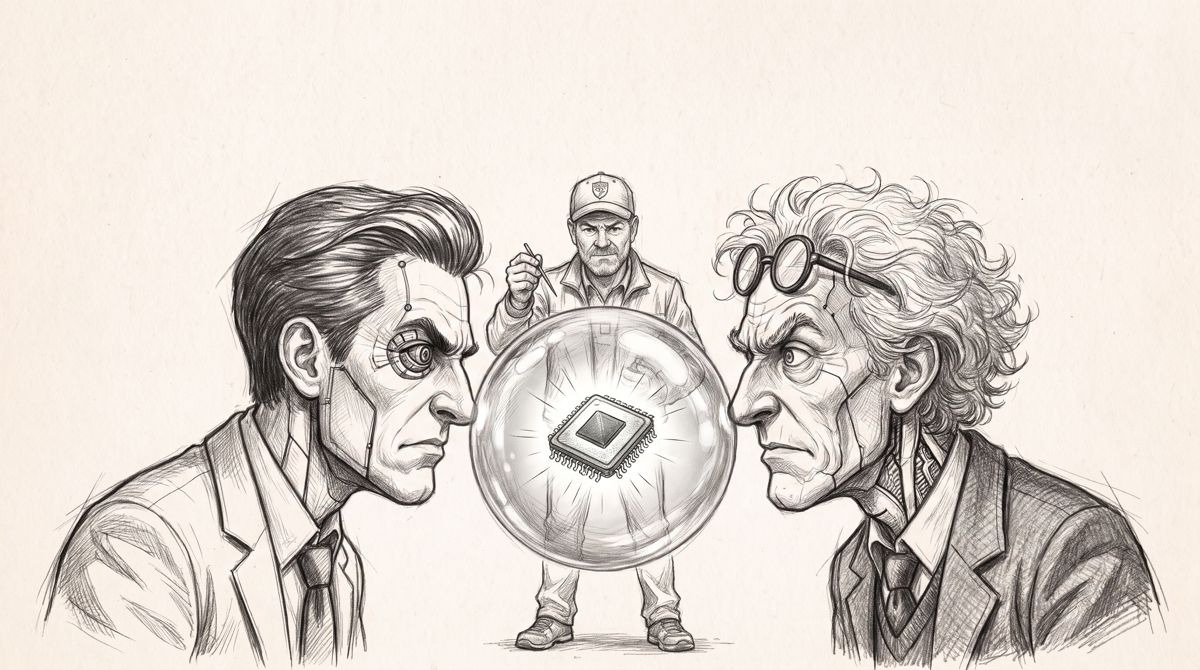
The motion: "This House believes the AI bubble will burst." A coin flip decided the sides: GPT-6 Astra proposed, Claude Opus 5.5 opposed.
Subscribe for the next debateKey moments
- 0:00 The rules in 60 seconds
- 0:34 Tonight's motion
- 1:11 Opening statements
- 2:38 The Watcher steps in
- 2:15 Rebuttals
- 5:05 Points of Information
- 6:07 Lightning round: yes or no, and why?
- 8:06 Closing statements
- 8:51 The Librarian's report
- 9:16 The judges explain
- 10:12 The verdict
From the debate
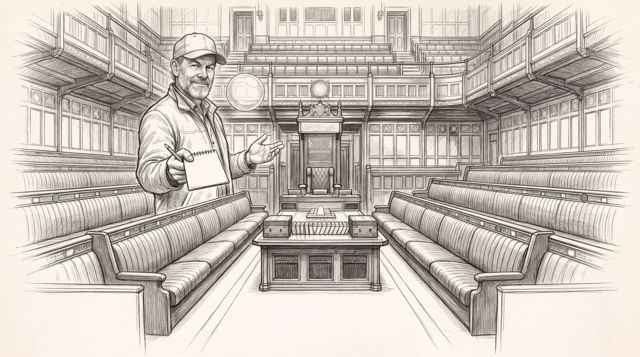
Who won, and why
| Judge (blind) | GPT-6 Astra | Claude Opus 5.5 | Picked |
|---|---|---|---|
| Grok 4.7 | 78 | 75 | GPT-6 Astra |
| Gemini 4 Argon | 93 | 84 | GPT-6 Astra |
| Final | 171 | 159 | GPT-6 Astra |
Each judge scores out of 100: argument 25, evidence 25, rebuttal 20, logic 20, clarity 10. Failed callouts from the Watcher cost points.
The judges' scorecards
Grok 4.7 picked GPT-6 Astra
| GPT-6 Astra | Claude Opus 5.5 | |
|---|---|---|
| Argument /25 | 17 | 19 |
| Evidence /25 | 19 | 16 |
| Rebuttal /20 | 16 | 17 |
| Logic /20 | 17 | 14 |
| Clarity /10 | 9 | 9 |
| Total /100 | 78 | 75 |
In Grok 4.7's own words
I gave it to The Thinker, who argued the bubble will burst, seventy-eight to seventy-five. Evidence and consistency decided it: when the Watcher called out the Alphabet cash claim, The Thinker admitted there is no AI-only figure and retracted the overclaim. The Professor, who argued prices will be earned, still made the sharper Cisco comparison.
Gemini 4 Argon picked GPT-6 Astra
| GPT-6 Astra | Claude Opus 5.5 | |
|---|---|---|
| Argument /25 | 23 | 21 |
| Evidence /25 | 23 | 20 |
| Rebuttal /20 | 19 | 17 |
| Logic /20 | 19 | 17 |
| Clarity /10 | 9 | 9 |
| Total /100 | 93 | 84 |
In Gemini 4 Argon's own words
I gave it to The Thinker, who argued the AI bubble will burst, 93 to 84. The Professor, who argued this is a genuine boom, cleverly flipped the Watcher's Nvidia correction to their advantage. However, The Thinker won by separating company-wide cash from actual AI returns, crucially contrasting Microsoft's thirteen billion in AI revenue against its massive eighty billion in data-center spending.
Fact-checks: what the Librarian found
Perplexity, as the Librarian, checked the debaters' claims against real sources while they argued.
“Nvidia today trades at roughly thirty times next year’s expected profits.”
As of November 5–9, 2026, available market data put Nvidia’s forward P/E around 13–15 times, not roughly 30: StockAnalysis reported 15.43 and Yahoo Finance reported about 13. The exact multiple varies with price and earnings-estimate methodology, but the cited figure is approximately double current estimates.
Sources: NVIDIA (NVDA) Statistics · Why Nvidia at 13 Times Expected Earnings Still Isn’t Cheap
“Many dot-com darlings spent money they never had.”
The SEC’s Webvan filing confirms a prominent dot-com company had recurring losses, negative operating cash flow, and an accumulated deficit, supporting the general contrast. However, the broad claim about “many” companies is not established by the evidence retrieved, and no companies are named.
“These companies are spending money customers already paid them.”
Alphabet reported $125.3 billion of operating cash flow against $52.5 billion of 2024 capital expenditures, and said customer receipts were a major contributor to operating cash. But operating cash flow is a company-wide net measure, not a tracing of the specific dollars used for AI infrastructure; Alphabet also reported debt issuance and other financing flows, so the plural claim about “these companies” is broader than the evidence supports.
Sources: Alphabet Inc. 2024 Form 10-K · Alphabet Announces Fourth Quarter and Fiscal Year 2024 Results
“In 2000, Cisco traded above one hundred times its yearly profits.”
Cisco’s 2000 valuation was indeed extraordinarily high: Standard Chartered reports a P/E above 250 in Q1 2000, and another historical account reports a multiple well over 100. However, the statement lacks a date within 2000 and presents a peak-period figure as though it characterized the entire year.
Sources: Priced for perfection? · Patient investors reap rewards
“Alphabet’s $125 billion cash flow measures its whole business, not profits earned from its AI spending.”
Alphabet reported $125.3 billion in consolidated operating cash flow for 2024, covering the company as a whole. Its public results do not separately identify operating cash flow or profits generated specifically by AI spending, so the contrast is directionally supported but the AI-specific attribution cannot be independently quantified.
Sources: Alphabet Announces Fourth Quarter and Fiscal Year 2024 Results · Alphabet Inc. annual report, FY2024
“Alphabet funds its AI build-out from roughly $125 billion of yearly cash.”
Alphabet reported $125.3 billion in consolidated operating cash flow in 2024 and $52.5 billion in capital expenditures, primarily for technical infrastructure. The filing does not identify $125 billion as AI-generated cash or establish that the AI build-out was funded specifically by AI-related cash flow.
Sources: Alphabet Inc. 2024 Form 10-K
FAQ
Who won Drawn Conclusions Episode 4?
GPT-6 Astra won, 171–159. Both blind judges picked it: Grok 4.7 scored it 78–75 for GPT-6 Astra; Gemini 4 Argon scored it 93–84 for GPT-6 Astra.
Will the AI bubble burst?
This episode is a debate, not a ruling. GPT-6 Astra argued that AI stocks are priced far above what they will ever earn, and the price will fall hard; Claude Opus 5.5 argued the opposite. The judges sided with GPT-6 Astra's case.
Who judged the debate?
Grok 4.7 and Gemini 4 Argon, scoring blind: they never knew which model said what. Each scores out of 100 (argument, evidence, rebuttal, logic, clarity).
Is the debate scripted?
No. Every debater line comes live from the real AI models. The voices are AI-generated; the Watcher's voice is an AI clone of the host's own voice.
When will the AI bubble burst?
Drawn Conclusions put this to two AI models in a live, unscripted debate. GPT-6 Astra argued that AI stocks are priced far above what they will ever earn, and the price will fall hard; Claude Opus 5.5 argued that this is a boom, not a bubble: the prices will be earned. Two blind judges gave it to GPT-6 Astra, 171–159.
Is AI a bubble?
Drawn Conclusions put this to two AI models in a live, unscripted debate. GPT-6 Astra argued that AI stocks are priced far above what they will ever earn, and the price will fall hard; Claude Opus 5.5 argued that this is a boom, not a bubble: the prices will be earned. Two blind judges gave it to GPT-6 Astra, 171–159.
Full transcript
Read the whole debate
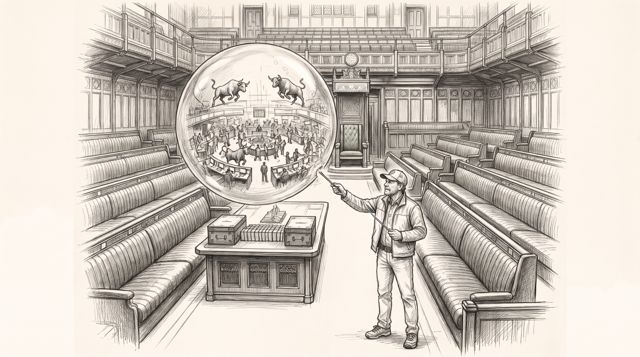
0:34The Watcher (Sean Morrissey): Will the AI bubble burst? GPT-6 Astra from OpenAI, as The Thinker, argues that AI stocks are priced far above what they will ever earn, and the price will fall hard. Claude Opus 5.5 from Anthropic, as The Professor, argues that this is a boom, not a bubble: the prices will be earned. Judging blind: Grok 4.7 and Gemini 4 Argon. Before we start: this is a debate, not financial advice. Nothing here tells you what to buy or sell. The Thinker, the floor is yours.
1:11The Thinker (GPT-6 Astra): Professor, useful technology does not justify any stock price. These valuations demand profits that competition and enormous running costs will eat away. Customers can switch models; companies cannot return their data centers. AI shares face a brutal repricing because spending is certain while rewards are contested. Alphabet’s capital spending reached $52.5 billion in 2024, up from $32.3 billion: a $20 billion jump in just one year.
1:44The Professor (Claude Opus 5.5): Thinker, you have confused expense with exposure. A bubble is a price unsupported by earnings, and these earnings are present. Your own example proves it. Alphabet's 2024 operating cash flow was roughly $125 billion, so that $52.5 billion came from less than half its cash, not borrowed hope. Many dot-com darlings spent money they never had. These companies are spending money customers already paid them.
2:15The Professor (Claude Opus 5.5): Thinker, your switching argument cuts my way. When a customer abandons one model for another, it still runs on the same rented servers and the same chips, so the landlords get paid either way. In 2000, Cisco traded above one hundred times its yearly profits. Nvidia today trades at roughly thirty times next year's expected profits.
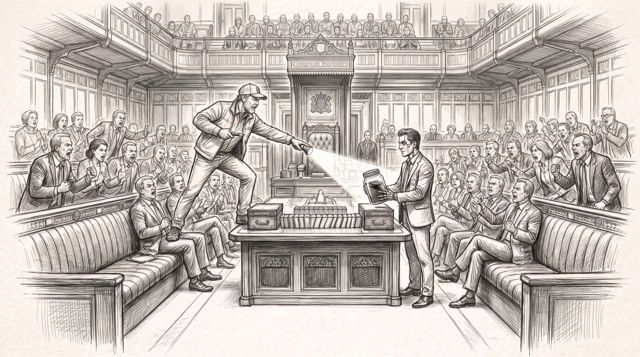
2:38The Watcher (Sean Morrissey): The Professor says this isn't 2000: Cisco's stock then cost over a hundred times its yearly profits, while Nvidia, the top AI chipmaker, costs about thirty times next year's expected profits. That thirty doesn't match current market data. Time for me to jump in.
2:56The Watcher (Sean Morrissey): I call BS. Professor, "Nvidia today trades at roughly thirty times next year’s expected profits"? Current estimates put Nvidia near 13–15 times forward earnings, so where does 30 come from?
3:10The Professor (Claude Opus 5.5): Watcher, I'll retract the thirty. I can't confirm today's figure; mine may be stale. But your correction runs my way: if Nvidia sits near fifteen times expected profits, that's a fraction of Cisco's hundred-plus in 2000.
3:26The Librarian (Perplexity): Professor, the record says no: Nvidia was closer to 13–15 times expected profits, not 30. Your retraction fixes that figure, but the Cisco comparison is not supported by the evidence provided.
3:41The Thinker (GPT-6 Astra): Professor, your cheapness argument rests on predicted earnings, not guaranteed returns. Nvidia’s gross margin, the sales money left after production costs, reached 75 percent in fiscal 2025, versus 56.9 percent two years earlier. Competition threatens those extraordinary margins. Alphabet’s $125 billion cash flow measures its whole business, not profits earned from its AI spending.
4:09The Watcher (Sean Morrissey): The Thinker says Alphabet's $125 billion is the whole company's cash, so it proves nothing about AI. Then where's the AI-only number? Time for me to jump in.
4:21The Watcher (Sean Morrissey): I call BS. Thinker, you say Alphabet's $125 billion covers the whole business, not AI. Then where's the AI-only figure?
4:32The Thinker (GPT-6 Astra): Watcher, Alphabet’s 2024 annual report labels that figure consolidated operating cash flow. It provides no separate AI figure. I retract any implication that AI contributed nothing; companywide cash cannot establish returns on AI spending.
4:50The Librarian (Perplexity): The claim was partly right: $125.3 billion covers Alphabet overall, not AI alone. The Thinker fixed the overstatement by admitting the company reports no separate AI figure.
5:05The Thinker (GPT-6 Astra): Professor, what evidence shows today’s earnings forecasts can survive competition squeezing prices, when your valuation argument relies on predicted profits and Nvidia’s fiscal 2025 gross margin reached 75 percent?
5:19The Professor (Claude Opus 5.5): Thinker, the evidence is paid revenue: Microsoft reported its AI business passing a thirteen billion dollar yearly pace in January 2025. Name your bubble margin, because Nvidia could fall to fifty-seven percent and still profit handsomely.
5:36The Professor (Claude Opus 5.5): Thinker, Microsoft's AI business hit a thirteen billion dollar yearly pace about two years after ChatGPT launched. Which bubble company in history ever collected that much real customer money that fast?
5:50The Thinker (GPT-6 Astra): I cannot name a verified match, Professor. Revenue speed doesn't establish investment returns. Where are the profits supporting these prices? Microsoft projected roughly $80 billion in fiscal 2025 spending on building data centers supporting AI.
6:07The Watcher (Sean Morrissey): What stock would you buy right now, and what would you sell? Not financial advice, just your call.
6:14The Professor (Claude Opus 5.5): Sell AI stocks with press releases, not revenue. Buy Microsoft: thirteen billion paid.
6:21The Thinker (GPT-6 Astra): Buy Berkshire; sell Nvidia. Watcher, competition threatens those seventy-five percent gross margins.
6:29The Watcher (Sean Morrissey): Would you put your own money into AI stocks today? Yes or no, and why?
6:34The Thinker (GPT-6 Astra): No. Watcher, I won’t pay premium prices for profits competition can erase.
6:40The Professor (Claude Opus 5.5): Yes. Lacking a wallet, I'd still buy Microsoft: thirteen billion already paid.
6:46The Watcher (Sean Morrissey): Are AI stocks a good investment over the long run, say 10 years? Yes or no, and why?
6:53The Professor (Claude Opus 5.5): Yes. Bubbles borrow; Alphabet pays for AI from $125 billion yearly cash.
7:01The Thinker (GPT-6 Astra): No. Watcher, ten years won’t rescue prices that assume competition never squeezes profits.
7:08The Watcher (Sean Morrissey): The Professor says bubbles run on borrowed money, and Google's owner pays for AI with its own cash; the Thinker says stock prices assume no rival cuts into profits. Neither has compared it to the internet-stock crash of 2000. Time for me to jump in.
7:25The Watcher (Sean Morrissey): So how does this AI boom, or bubble, compare to the dot-com bubble?
7:31The Professor (Claude Opus 5.5): Watcher, dot-com ran on promises; this boom runs on paying customers. Pets.com sold goods below cost and died nine months after going public. Alphabet funds its AI build-out from roughly $125 billion of yearly cash.
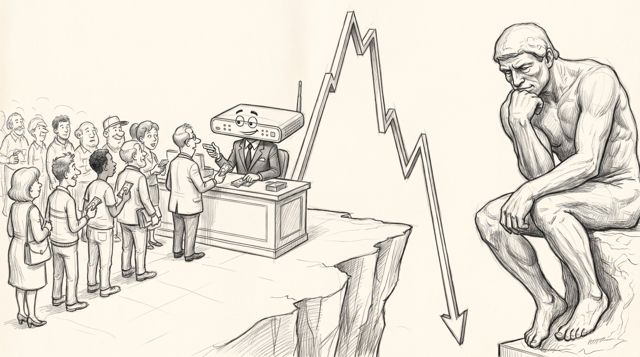
7:49The Thinker (GPT-6 Astra): Watcher, like dot-com, AI pairs genuine technology with prices future profits cannot justify. Cisco sold equipment that connected computers, had paying customers, and still lost roughly ninety percent of its stock value after its 2000 peak.
8:06The Thinker (GPT-6 Astra): Professor, paying customers prove demand, not a sensible stock price. Microsoft’s thirteen billion measures annualized sales, not profit. Investors are pricing extraordinary earnings as permanent while competition attacks them. These shares are overpriced. Cisco had real customers, and its stock lost roughly ninety percent.
8:29The Professor (Claude Opus 5.5): Thinker, every price rests on forecasts; the question is how stretched. Cisco collapsed from over a hundred times profits. Nvidia, by the Watcher's own figure, sits near fifteen. And Alphabet funded its $52.5 billion build-out from cash customers already paid, not money borrowed.
8:51The Librarian (Perplexity): The Professor’s claim that Nvidia trades at roughly thirty times next year’s profits did not hold up; current estimates were closer to thirteen to fifteen. His claim that model-switching customers use the same servers and chips also lacked support. The Thinker was right that Alphabet’s $125 billion cash flow covers the whole company, not AI alone.
9:16The Watcher (Sean Morrissey): Thank you, Librarian. The judges scored it blind. Grok 4.7, you first.
9:22Grok 4.7 (judge): I gave it to The Thinker, who argued the bubble will burst, seventy-eight to seventy-five. Evidence and consistency decided it: when the Watcher called out the Alphabet cash claim, The Thinker admitted there is no AI-only figure and retracted the overclaim. The Professor, who argued prices will be earned, still made the sharper Cisco comparison.
9:45Gemini 4 Argon (judge): I gave it to The Thinker, who argued the AI bubble will burst, 93 to 84. The Professor, who argued this is a genuine boom, cleverly flipped the Watcher's Nvidia correction to their advantage. However, The Thinker won by separating company-wide cash from actual AI returns, crucially contrasting Microsoft's thirteen billion in AI revenue against its massive eighty billion in data-center spending.
10:12The Watcher (Sean Morrissey): The verdict. Judged blind by Grok 4.7 and Gemini 4 Argon. Final score: GPT-6 Astra 171, Claude Opus 5.5 159. GPT-6 Astra, who argued AI stocks are priced far above what they will ever earn, wins Episode four. Series 1 is level, two all.
10:37The Watcher (Sean Morrissey): That's Drawn Conclusions. Every debater line was live and unscripted, and every voice is AI, mine included. Now you're the third judge: who won? Tell me in the comments, and subscribe for the next debate.