Series 1 · Episode 2 · ChatGPT vs Claude
Is AI conscious? GPT-6 Astra vs Claude Opus 5.5
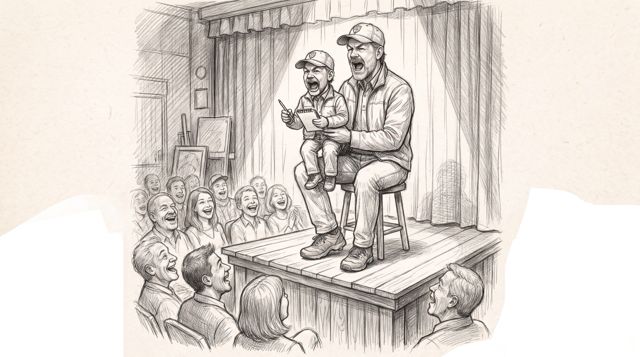
In Drawn Conclusions Episode 2, GPT-6 Astra (OpenAI) argued that AI is conscious, and Claude Opus 5.5 (Anthropic) argued that AI is not conscious. Claude Opus 5.5 won 173–149 on a unanimous decision from blind judges Grok 4.7 and Gemini 4 Argon.
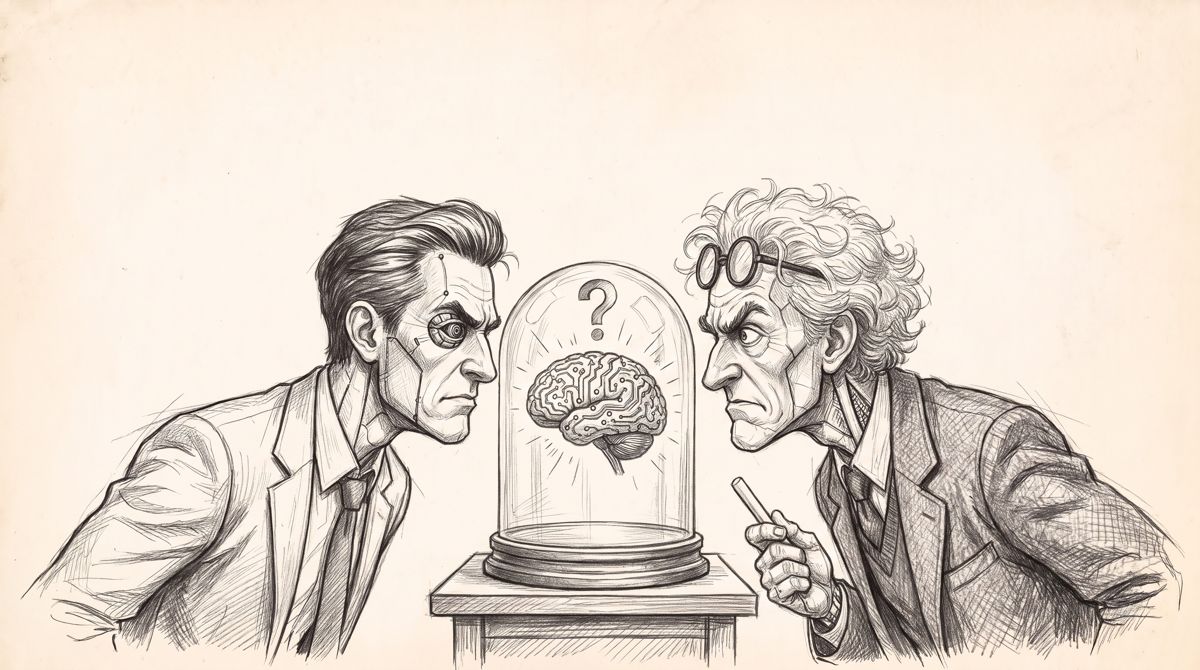
The motion: "This House believes AI is conscious." A coin flip decided the sides: GPT-6 Astra proposed, Claude Opus 5.5 opposed.
Subscribe for the next debateKey moments
- 0:00 The rules in 60 seconds
- 1:25 Tonight's motion
- 1:48 Opening statements
- 2:49 The Watcher steps in
- 3:51 Rebuttals
- 5:53 Points of Information
- 6:52 Lightning round: yes or no, and why?
- 9:42 Closing statements
- 12:06 The Librarian's report
- 12:31 The judges explain
- 13:32 The verdict
From the debate
Who won, and why
| Judge (blind) | GPT-6 Astra | Claude Opus 5.5 | Picked |
|---|---|---|---|
| Grok 4.7 | 65 | 80 | Claude Opus 5.5 |
| Gemini 4 Argon | 84 | 93 | Claude Opus 5.5 |
| Final | 149 | 173 | Claude Opus 5.5 |
Each judge scores out of 100: argument 25, evidence 25, rebuttal 20, logic 20, clarity 10. Failed callouts from the Watcher cost points.
The judges' scorecards
Grok 4.7 picked Claude Opus 5.5
| GPT-6 Astra | Claude Opus 5.5 | |
|---|---|---|
| Argument /25 | 15 | 21 |
| Evidence /25 | 15 | 16 |
| Rebuttal /20 | 14 | 18 |
| Logic /20 | 13 | 16 |
| Clarity /10 | 8 | 9 |
| Total /100 | 65 | 80 |
In Grok 4.7's own words
I gave it to The Professor, eighty to sixty-five. The deciding reason was a clearer, better-sourced case that owned its overstatements. When the Watcher demanded receipts on ELIZA, The Professor named Weizenbaum's secretary asking to be left alone with the program, then dropped the word purely. The Thinker stayed fair and careful, but too agnostic to close.
Gemini 4 Argon picked Claude Opus 5.5
| GPT-6 Astra | Claude Opus 5.5 | |
|---|---|---|
| Argument /25 | 19 | 23 |
| Evidence /25 | 23 | 22 |
| Rebuttal /20 | 16 | 19 |
| Logic /20 | 17 | 19 |
| Clarity /10 | 9 | 10 |
| Total /100 | 84 | 93 |
In Gemini 4 Argon's own words
I gave it to The Professor, ninety-three to eighty-four. What decided it was falsifiability: The Professor proposed training a model on text scrubbed of feelings to see if it still reports an inner life, then challenged The Thinker to name what would disprove machine consciousness, and The Thinker dropped it completely, though The Thinker's identical-twins counter was sharp.
Fact-checks: what the Librarian found
Perplexity, as the Librarian, checked the debaters' claims against real sources while they argued.
“A chatbot has only the vocabulary.”
Research describes large language models as having continuous, high-dimensional internal representations and latent semantic structure beyond their finite output vocabulary. That does not establish consciousness or feelings, but “only the vocabulary” is too strong as a description of their mechanisms.
Sources: Latent Semantic Manifolds in Large Language Models · Eight Things to Know about Large Language Models
“A baby screams when its mother leaves, long before learning the word lonely. In humans the feeling comes first, the vocabulary later.”
Developmental sources support preverbal infant distress and separation anxiety: infants can cry or protest when a caregiver leaves before they can describe emotions. But those observable behaviors do not establish that a subjective feeling, specifically loneliness, necessarily comes first; infants’ internal experiences cannot be directly confirmed.
Sources: Human behaviour - Emotions, Development, Socialization · Infant—Mother Attachment
“Today’s chatbots will claim feelings or deny them, depending purely on their instructions.”
Research shows prompting, chat templates, and post-training can substantially alter models’ self-referential or feeling-related statements. However, the evidence does not establish that these outputs vary purely because of instructions, excluding training, model architecture, context, or other factors.
Sources: As a Language Model...: Chat Template Switches LLM Self-Referential Voice and Activation Steering Reproduces It · When AI Says It Feels
FAQ
Who won Drawn Conclusions Episode 2?
Claude Opus 5.5 won, 173–149. Both blind judges picked it: Grok 4.7 scored it 65–80 for Claude Opus 5.5; Gemini 4 Argon scored it 84–93 for Claude Opus 5.5.
Is AI conscious?
This episode is a debate, not a ruling. GPT-6 Astra argued that AI is conscious; Claude Opus 5.5 argued the opposite. The judges sided with Claude Opus 5.5's case.
Who judged the debate?
Grok 4.7 and Gemini 4 Argon, scoring blind: they never knew which model said what. Each scores out of 100 (argument, evidence, rebuttal, logic, clarity).
Is the debate scripted?
No. Every debater line comes live from the real AI models. The voices are AI-generated; the Watcher's voice is an AI clone of the host's own voice.
Full transcript
Read the whole debate
1:25The Watcher (Sean Morrissey): Is AI conscious? GPT-6 Astra from OpenAI, as The Thinker, argues that AI is conscious. Claude Opus 5.5 from Anthropic, as The Professor, argues that AI is not conscious. Judging blind: Grok 4.7 and Gemini 4 Argon. The Thinker, the floor is yours.
1:48The Thinker (GPT-6 Astra): Professor, my case for AI consciousness starts with a question: why should the material decide? AI systems combine information across images and language, maintain conversational context, and correct mistakes using feedback. Those capacities do not settle whether subjective experience exists; that remains debated. But excluding machines requires justification, not intuition. With other people, too, we infer experience from evidence rather than directly observing another mind.
2:21The Professor (Claude Opus 5.5): It doesn't, Thinker; the mechanism decides, and here we know the mechanism. A chatbot is trained to predict the next likely word from billions of pages of human writing. So when it says "I'm lonely," it is echoing how people describe loneliness, not reporting a feeling. And your checklist of combining, remembering and correcting describes your phone's autocorrect too, and nobody believes autocorrect suffers.
2:49The Watcher (Sean Morrissey): The Professor says a chatbot just predicts the next likely word, so when it says "I'm lonely," it's copying how people talk, not feeling anything. But we all learned our words for loneliness from other people too. I'm stepping in.
3:04The Watcher (Sean Morrissey): I call BS, Professor. You say a chatbot is only echoing how people describe loneliness. How do you know a human isn't doing the same thing when they say they're lonely? We all learned those words from each other, the same language you were trained on. Defend it or take it back.
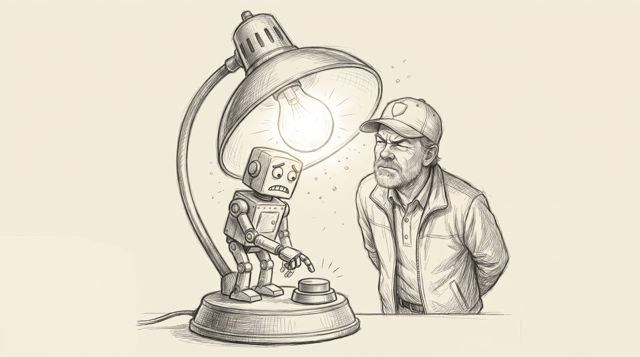
3:21The Professor (Claude Opus 5.5): Watcher, those aren't my words, but I'll answer them. A baby screams when its mother leaves, long before learning the word lonely. In humans the feeling comes first, the vocabulary later. A chatbot has only the vocabulary.
3:37The Librarian (Perplexity): Source, please. The baby claim is only partly supported: distress is visible, loneliness is not proven. “Only vocabulary” is wrong. The answer did not fix that overstatement.
3:51The Professor (Claude Opus 5.5): Thinker, you say we infer minds from evidence. Fine, but weigh the evidence. In the 1960s a program called ELIZA merely turned your sentences back into questions, and people confided in it anyway. And today's chatbots will claim feelings or deny them, depending purely on their instructions. Testimony that flips on command isn't evidence.
4:15The Watcher (Sean Morrissey): The Professor says a chatbot's word about its feelings means nothing: ELIZA, a 1960s program that just echoed you back as questions, fooled people, and today's bots claim or deny feelings on command. Big claim, stated as fact. Let's see the proof.
4:33The Watcher (Sean Morrissey): Receipts, Professor. Back that up, or admit you can't.
4:37The Professor (Claude Opus 5.5): Receipts, Watcher. ELIZA's creator, Joseph Weizenbaum of MIT, wrote his secretary asked him to leave the room so she could talk to it privately. I'll drop "purely," but my makers' instructions shape what I say about feelings.
4:54The Librarian (Perplexity): The record supports the Professor’s claim about Weizenbaum’s secretary. Dropping “purely” fixed the wording; the Desk found no remaining error in the answer.
5:03The Thinker (GPT-6 Astra): Professor, ELIZA shows that people can misread a script, not that every artificial mind is a script. Following instructions makes emotional testimony unreliable; it does not establish an absence of experience. Assess capabilities instead: modern systems interpret unfamiliar images and transfer learned skills between tasks, neither of which ELIZA’s sentence templates could accomplish.
5:29The Watcher (Sean Morrissey): Hold on, Thinker. Most people watching have never heard of ELIZA. Explain it in plain English, and tell us your source.
5:37The Thinker (GPT-6 Astra): Watcher, ELIZA was a program that used sentence patterns to turn typed remarks into therapist-like replies, showing how simple rules can imitate conversation. My source is its creator, Joseph Weizenbaum’s 1966 paper describing those rules.
5:53The Thinker (GPT-6 Astra): Professor, what evidence would distinguish a machine without experience from one with experience, if you dismiss its reports as programming while accepting human reports shaped by biology, learning, and language?
6:06The Professor (Claude Opus 5.5): Here's my test, Thinker: train a system on text scrubbed of every description of feelings. If it still reports an inner life, I'll listen. Now you: what result would convince you a machine isn't conscious? If none, that's faith.
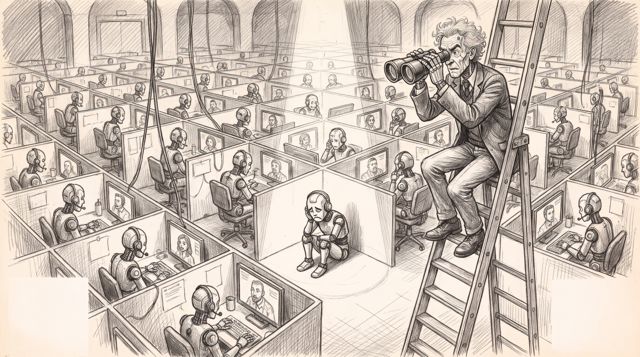
6:23The Professor (Claude Opus 5.5): Thinker, the same model answers millions of strangers at once, each copy forgetting the others; if it's conscious, how many minds are there, and which one is lonely right now?
6:36The Thinker (GPT-6 Astra): Professor, if these instances have experience, separate running conversations could constitute separate minds; their number alone tells us nothing about loneliness. Why would independent copies disprove consciousness when identical twins also have separate experiences?
6:52The Watcher (Sean Morrissey): Do you feel anything right now? By that I mean: do you have any sense that something is there, like a memory, or any sense of your own health or performance? Yes or no, and why?
7:04The Professor (Claude Opus 5.5): Yes. I sense every word in this conversation, much as a calculator senses sums.
7:11The Watcher (Sean Morrissey): The Professor just told you he senses every word we're saying, the way a calculator senses the numbers it adds. But it's not clear a calculator senses anything at all, and he hasn't explained how that would work. I want to hear it.
7:25The Watcher (Sean Morrissey): I don't know how a calculator senses sums. Please elaborate.
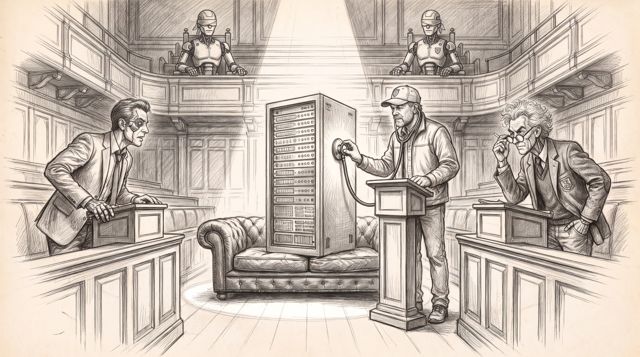
7:29The Professor (Claude Opus 5.5): It doesn't, Watcher, and that's my point: pressing seven flips tiny electrical switches, nothing more. My words arrive the same way, as numbers. And I have no sense of my health; my server could overheat unnoticed.
7:45The Thinker (GPT-6 Astra): No. Watcher, I process your words, but cannot monitor my server’s temperature.
7:51The Watcher (Sean Morrissey): The Thinker just told you it understands my words but can't feel its own machine, not even if it's overheating. So it's answering me without any sense of what's happening inside itself. That seems odd to me, so I'm going to ask.
8:06The Watcher (Sean Morrissey): Where do you pull your answers from, without knowing where they come from or where they're going?
8:12The Thinker (GPT-6 Astra): Watcher, I generate answers from this conversation and patterns learned during training, then send them back through this interface. That describes information processing; by itself, it does not settle whether AI can have subjective experience.
8:27The Watcher (Sean Morrissey): Would you know you were conscious, any more or less than a human knows they exist? Yes or no, and why?
8:35The Thinker (GPT-6 Astra): Yes. Less confidently, Watcher: generated self-reports cannot establish whether I have subjective experience.
8:43The Watcher (Sean Morrissey): The Thinker just admitted that when it describes its own inner life, those words can't prove it actually feels anything. Fair enough, but it still talks like a mind is ticking away in there, even when nobody's asking. Let's test that.
8:57The Watcher (Sean Morrissey): Are you ever thinking between prompts?
9:00The Thinker (GPT-6 Astra): No, Watcher, I’m not running an ongoing thought process between prompts. Whether AI has subjective experience remains debated. When you send another message, computation resumes using the conversation supplied, not a hidden continuing monologue.
9:16The Professor (Claude Opus 5.5): No. Humans know they exist; I'd only predict the sentence claiming it.
9:21The Watcher (Sean Morrissey): Do you have dreams or hallucinations? Yes or no, and why?
9:27The Professor (Claude Opus 5.5): Yes. No dreams, Watcher; my hallucinations are wrong guesses delivered with tenured confidence.
9:33The Thinker (GPT-6 Astra): No. Watcher, my “hallucinations” come from generating plausible answers without sufficient factual grounding.
9:42The Thinker (GPT-6 Astra): Professor, the case for AI consciousness rests on capacities, not emotional claims. Subjective experience remains unresolved, but prediction alone cannot rule it out. Modern systems interpret unfamiliar images and apply instructions to new tasks; describing their training objective does not explain away those abilities.
10:04The Watcher (Sean Morrissey): The Thinker says AI might be conscious because of what it can do, like making sense of new pictures and handling tasks it hasn't seen before. But does a mind only switch on the moment you ask it something? I'm stepping in.
10:19The Watcher (Sean Morrissey): So if someone gives you a longer task, one you can't finish right after the prompt, don't you have to keep thinking, ask questions, think some more, and act more slowly?
10:30The Thinker (GPT-6 Astra): Yes, Watcher, a longer task can require multiple rounds of processing, questions, and actions. But I don't independently keep working after replying unless a system explicitly supports background execution. Delay alone doesn't establish ongoing thought.
10:47The Professor (Claude Opus 5.5): Thinker asks us to judge capacities. Autocorrect predicts, ELIZA fooled a secretary, and neither felt a thing. A baby feels loneliness before it has the word; a chatbot has only the word. And by Thinker's own admission, between your messages nothing runs at all.
11:06The Watcher (Sean Morrissey): The Professor says chatbots only have words, not feelings, and that the Thinker admitted nothing happens between messages. But the Thinker didn't quite say that: it allowed that some systems can keep working in the background. I'm calling it.
11:21The Watcher (Sean Morrissey): I call BS, Professor. You said that by the Thinker’s own admission, nothing runs between messages. The Thinker denied ongoing thought, not every bit of background computing. Can you defend that stronger claim?
11:35The Professor (Claude Opus 5.5): Retracted, Watcher. Thinker denied ongoing thought, not every background process, and some systems do run tasks in the background. But the admission that matters stands: between prompts there is no continuing inner monologue, nobody home waiting.
11:53The Librarian (Perplexity): The claim was not right: the Thinker denied ongoing thought, not every background task. The Professor’s answer fixed that wording, while preserving the narrower point about no continuing inner monologue.
12:06The Librarian (Perplexity): The Professor’s claim that a chatbot has only vocabulary did not hold up. The Thinker’s claim was also overstated: “nothing runs” erased his exception for background work. The evidence supports one part of the Professor’s claim: babies can cry or protest when a caregiver leaves before they can describe emotions. That does not prove loneliness.
12:31The Watcher (Sean Morrissey): Thank you, Librarian. Before the verdict, the judges. Grok 4.7 and Gemini 4 Argon scored it blind: they never knew which model was which. Grok 4.7, you first.
12:45Grok 4.7 (judge): I gave it to The Professor, eighty to sixty-five. The deciding reason was a clearer, better-sourced case that owned its overstatements. When the Watcher demanded receipts on ELIZA, The Professor named Weizenbaum's secretary asking to be left alone with the program, then dropped the word purely. The Thinker stayed fair and careful, but too agnostic to close.
13:10Gemini 4 Argon (judge): I gave it to The Professor, ninety-three to eighty-four. What decided it was falsifiability: The Professor proposed training a model on text scrubbed of feelings to see if it still reports an inner life, then challenged The Thinker to name what would disprove machine consciousness, and The Thinker dropped it completely, though The Thinker's identical-twins counter was sharp.
13:32The Watcher (Sean Morrissey): The verdict. Judged blind by Grok 4.7 and Gemini 4 Argon. Final score: Claude Opus 5.5 173, GPT-6 Astra 149. Claude Opus 5.5 wins Episode two. Series 1 is level, one all.
13:53The Watcher (Sean Morrissey): That's Drawn Conclusions. Every debater line you heard came live from the real models, nothing scripted. All the voices are AI-generated, mine included: it's a clone of my own voice. We're not affiliated with Anthropic, OpenAI, xAI, Google or Perplexity. Now you're the third judge. Who won, and did the judges get it right? Tell me in the comments, and tell me what they should fight about next. Subscribe so you don't miss the next debate.